Organizational Development And Change Solutions
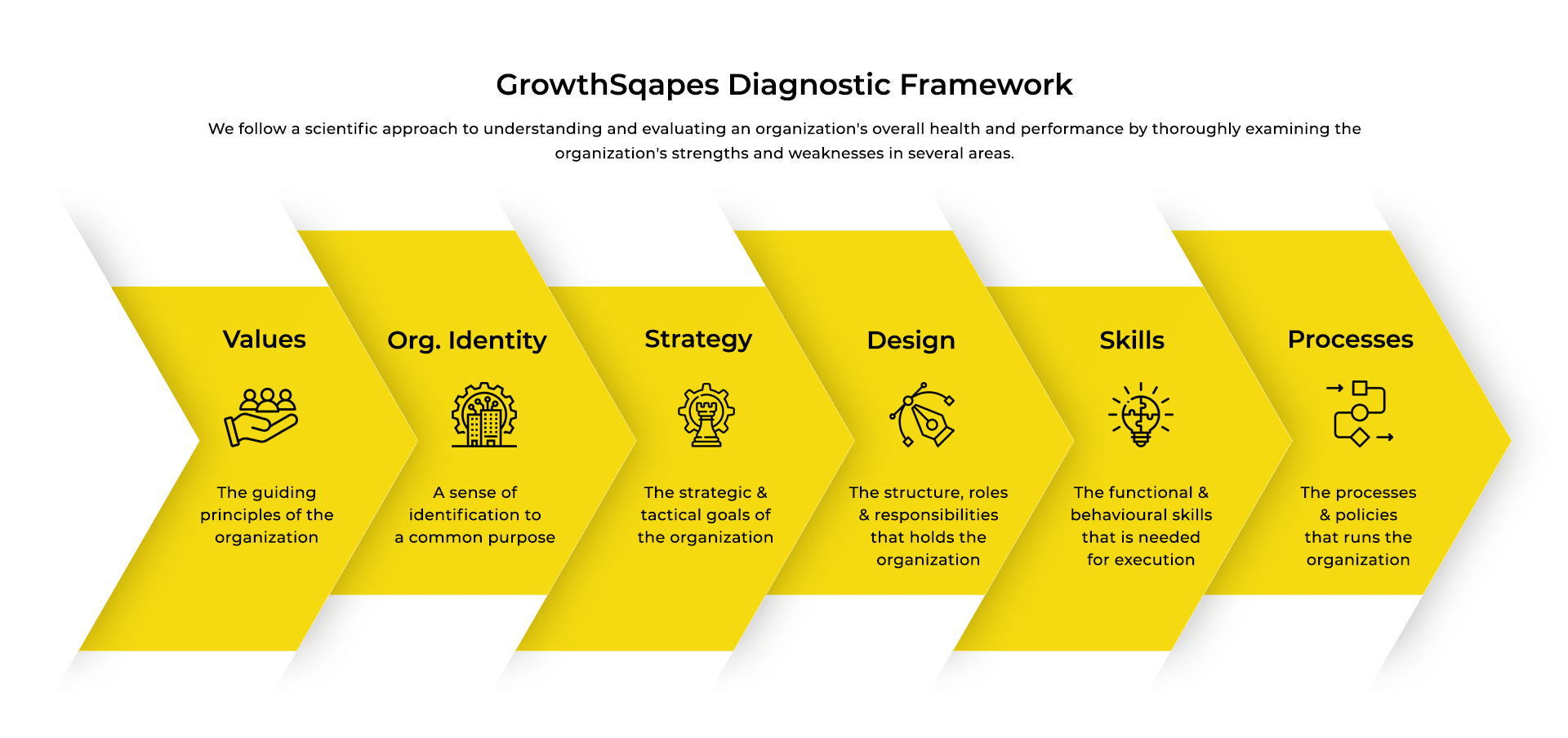
Organizational Diagnosis
Strategic Impetus
For any business organization to develop a strategic direction and a roadmap, it is imperative that it first establishes a widely shared understanding of its system, basis which it would gain an understanding of where it stands today and where does it want to reach in future. Our VITOHScope is a diagnostic tool that is a reliable predictor and is used to establish this comprehensive systemic understanding of the organization.
Performance & Operational Impetus
Often organizations run fine and nothing abnormal meets the eye. Yet, metrics that measure the business performance slip down, indicating falling operational performance. Our ADM Diagnoscope is deployed to identify areas in a strategic business unit, department, division, or a workgroup to accurately identify the hidden unseen causes that are having an adverse impact on the business’s operational performance.

Objectives
- Diagnose all vital organs of the organization like People Processes, Systems, Context and Climate, Strategic Intent, Role Orientation.
- Accurately report diagnostic information on key parameters like business process efficiencies, performance orientation, human conflicts and communication status, people capability gaps, leadership quality and focus, cultural dimensions, value orientation, task orientation, technology, structure, and long-term strategy.
- Identifies the possible unseen causal linkages to the symptoms of the organization’s operational problems.
- Inform about the possible health issues in the organization so that appropriate interventions can be made on time.
Business Impact for the Organization
- Organization’s benefit by way of getting a first-hand realistic and objective report on the exact health status of the various parts and organs of the organization.
- Such an a priori approach, either before a strategic jump or adopting any tactical change gives the owners, the leaders, the managers and the employees, a level of sure-footed preparedness.
- Lays the foundation for a competitive strategy in the dynamic world.
- Makes the entire business strategy stand on a planned professional approach and not adopting ad-hoc, arbitrary goals without empirical methods.
Design Element
Delivery Elements

Organizational Vision, Mission & Strategy
FOR WHOM? WHEN REQUIRED?
GrowthSqapes offers structured exploratory vision workshops for private, public, start-ups, SMEs and NGOs. Vision and mission workshops are maps that get installed in the minds of the owners, leaders and employees of an organization, which route the ‘origin’ and ‘destination’ of the business for a given timeline. It is imperative for existing as well as for new-age businesses, given the shifting momentums and velocities of doing business and, time and technology transitions.
Objectives
- To get a clear, communicated, feasible and time-bound goal as a destination to reach.
- Come out of a foggy yet aspirational core reason for its existence to define and believe in a clear reason to exist as a business.
- Overcome business myopia and envision a business mission.
- Map the future state, the next steps, the constraints and the opportunities to craft a competitive advantage to enter a planned future.
Business Impact for the Organization
- Creation of a ‘Here and Now’ to ‘There and Then’ strategic roadmap and business metrics to measure, monitor, manage.
- The organization gets a collective belief, a clarion call and a guiding principle to proceed.
- Vision and mission acts as foundations of business strategy building.
- Creation of a lighthouse to guide a long-term brand creation.
Design Elements
Delivery elements
Organizational Values & Culture Orientation
As an intervention values & culture orientation is of utmost significance when the organization experiences instances of mergers, amalgamations and acquisition of two or more business units. Such intervention also becomes a pre-requisite for culture building and change management in transitionary phases of a long-existing organization with a large employee base and multiple business units.
Objectives
- Re-orient the employees to the organization’s core values to enable adherence to values.
- Develop a pool of in-house organisation change consultants.
- Understanding the dimensions of culture.
- Knowing the ways in which each individual contributes to the culture building of the whole organization
- Generate an acceptance of ‘newer ways of working’ with newer people ‘in a changing environment’.
Business Impact for the Organization
- Helps the business to prepare and enter the change rather than experience an ‘on-the-face’ jolt of change.
- Gives a framework for understanding and application of value-based decision making.
- Build a collective, participative culture than a workplace culture that is seen as a thrust regime.
- Values and culture orientation adds positively to the sustainability of the organization.
Design Elements
Delivery elements
Organizational HR Advisory Services
Today, business organizations, business owners and corporate executives fully agree that Human Resource Management (HRM) is an important function, but involves a lot of cost. Additionally, for many businesses organizations it is not their expertise or a core function that directly helps them generate sales and revenue. In today’s uncertain, highly competitive and constantly evolving VUCAD/BANI business environment, it is important that businesses focus their attention and resources on their core business functions. However, at the same time, the Human Resources Management function cannot be ignored as it is important to keep the workforce motivated, help drive company culture and fill the talent gaps in the organization among other important organizational aspects, all of which directly impacts business results.
As a consulting organization, Growthsqapes is in the area of delivering multiple aspects of Human Resource Management consulting services and Human Resource Advisory (HR Advisory) as an external service provider, to large organizations as well as SMEs. With professional expertise and domain knowledge of multiple industries and sectors, through our HR advisory services, our aim is to make your organization future ready.
Services offered
- HR Audits & Diagnostics
- HR Advisory Services
- HR Policy formulation & review
- Strategic HR Consulting Projects
- Organizational re-structuring
- Compensation and Benefits design and benchmarking
- Rewards and incentives strategizing and design
- Statutory compliance
- Policy benchmarking
Objectives
- Bring HR Consulting and expertise on the table for the client
- Offer cost effective and efficient solutions that create business impact
- Create circumstances that allow the client to focus on their core business
- Minimize regulatory and compliance risks for clients
- Offer objective feedback on client’s existing HR capabilities
Business Impact for the Organization
- Creation of a ‘Here and Now’ to ‘There and Then’ strategic roadmap and HR metrics to measure, monitor and manage change.
- The organization gets a collective belief, a clarion call and a guiding principle to proceed in HR matters.
- Benchmarked policies and practices act as foundations of HR strategy building.
- Creation of a lighthouse to guide a long-term employer branding
Design Elements
Delivery elements
Team Outbound Training & Executive Retreat
Outbound Training (OBT) is an evidence based effective training method for enhancing employee and team behaviours and organisational performance through participation in indoor/outdoor activities using the experiential learning methodology. OBT is used to enhance the effectiveness and performance of employees through use of experiential learning activities and games using adult learning principles. OBT generally revolves around indoor/outbound activities designed to improve leadership, communication skills, performance, planning, change management, delegation, teamwork and motivation. Participants are engaged into various activities and games that give an immersive learning experience and bring out variety of learning outcomes based on the participants and organisational learning needs.
Executive retreat (ER) is a team building, team development or any other specific agenda driven approach designed for business leaders and executive-level managers that is conducted off-site at an exotic location and typically lasts from a few days to a week.
GrowthSqapes carries the full capacity and capability to conduct OBT and ER across various locations.
Objectives
- Create an environment for the team members to develop the ability to adapt, grow, bond and succeed as teams in a fun or adventurous way.
- Help team members focus on tackling challenging scenarios that involve strategizing, problem solving, decision making, communications, risk taking etc.
- To create a collaborative and synergistic work culture
- Foster employee engagement, employer branding and employee well-being through celebration.
When should it be done
- Organization wide employee meets across levels.
- Department wise/function wise employee meets.
- Sales/Service team meets or off-site.
- Channel partners engagement programs.
- New joinee induction programs.
Key learning for participants
- A fun-based learning experience that is followed by reflection, discussion, analysis and evaluation of the experience.
- Ways to apply the newly formed concepts and ideas back to the workplace.
- Introduction to the larger organization
- Ways to de-stress and improve the fun quotient at the workplace.
Business impact for organization
- Improved team bonhomie that helps in improving the teamwork abilities and resolving intragroup or personal conflicts.
- Identification of leadership qualities.
- Improved communication among all stakeholders resulting in better partnerships and alliances.
- Higher level of employee engagement and motivation in team members.
Design elements
Delivery elements
Mergers & Acquisitions: The Growth Chemistry of Business
Mergers and acquisitions (M&A) are business terms to describe situations in which businesses consolidate or one business acquires another. This being a business reality of today, business organizations may opt for this process for a variety of reasons. M&A are carried out for reasons that are allowed under the mergers and acquisitions law of each country. It’s benefits include elimination of excess workforce, growth acceleration, technology and the procurement of new talent. By merging or acquiring firms, business organizations overcome competition, attain economies of scale, acquire a monopoly, and multiply profits.
However, the disadvantages cannot be overlooked either. It involves a significant level of risk—acquisitions are expensive. Such changes in ownership can adversely impact a firms’ stock prices. Cultural difference is a huge hurdle—newly formed teams always take time to work smoothly. The overvaluation of a target firm can result in huge financial losses. In M&As, many employees lose their jobs—due to the duplicity of roles. Owing to the above, M&A between two business entities often comprises complex processes that involve significant changes to the organizational structure, culture, financials and operations of both entities. Working to ensure a smooth transition is critical in avoiding merger and acquisition problems
As a consulting organization, we recommend treating M&A not only as a financial transaction but also as an Organizational Development (OD) intervention, essentially for several diverse reasons. Towards the same, Growthsqapes functions as your close partner for all aspects of M&A. At Growthsqapes, we leverage the unrivalled knowledge and data-driven insights of our professionals to guide you seamlessly through the crucial business and human aspect of M&A.
Services offered (Consulting & Guidance)
Growthsqapes partners with clients in the following areas during M&A:
- Buy-side & sell-side Shortlisting:Thorough evaluation of product-market, technology and finding presence of intangibles in the possible merging/combining entities.
- Synergy Estimation: Identifying visible and latent sources of economic benefits of the deal.
- Valuation & Deal Pricing:Applying agreed valuation methods to arrive at fair valuation.
- Payment and Valuation Risk Mitigation:Devising payment method to neutralise valuation risks.
- Legal Advice:Compliance of various laws affecting deal structuring, implementation and integration.
- Managing Change: M&A transactions bring about substantial changes within organizations, including changes in leadership, reporting structures, job roles, and processes. By applying OD principles and methodologies, organizations can effectively plan and execute the necessary organizational changes, minimize resistance, and ensure a smooth transition for employees.
- Cultural Integration: Cultural integration is a critical aspect of M&A. Our OD interventions help organizations identify cultural gaps, develop strategies for aligning and blending cultures, and facilitate a harmonious integration of the two entities.
- Team Integration: M&A involves bringing together teams from different organizations with potentially different work styles, norms, and team dynamics. Our OD interventions can help integrate these teams by promoting open communication, building trust, and facilitating team-building activities.
- Leadership Development: M&A transactions often require new leadership structures and roles. Our OD interventions can support the development of integration leaders who can effectively guide the merged entity. This may involve leadership assessments, coaching, and leadership training programs to enhance leadership capabilities and adaptability in the context of the M&A.
- Talent Management: M&A can have a significant impact on the talent landscape of both entities. Our OD interventions can help organizations assess, align, and develop talent within the merged entity.
- Communication and Stakeholder Engagement: Our OD interventions provide frameworks and tools for designing communication plans, conducting stakeholder analysis, and facilitating meaningful dialogue. By leveraging OD practices, organizations can foster trust, mitigate resistance, and build a shared understanding of the M&A process among stakeholders.
- Organizational Design and Structure: M&A often necessitates changes in the organizational design and structure to optimize efficiency, streamline operations, and align with the strategic objectives of the merged entity. OD interventions can assist organizations in redesigning structures, clarifying roles and responsibilities, and establishing effective governance mechanisms. This ensures that the organizational design supports the new strategic direction and facilitates the integration process.
- Building internal HR/OD Managers: Growthsqapes partners with clients’ internal HR & OD team is to augment their focus and competence on building integration leaders within the organization.
Objectives
This interdisciplinary programme aims at:
- Understanding how to grow fast through inorganic combination of related or unrelated businesses.
- Appreciating that M&A can outperform green-field or grey-field expansions.
- Comprehending what drives value of the merging business.
- Understanding how investors and other stake holders gain through M&A.
Who should attend?
Our pre and post M&A consulting and guidance should be attended by:
- Corporate managers responsible for strategic growth initiatives including CXOs.
- Owners/CEOs/CFOs of family-owned un-listed companies and SMEs.
- Corporate lawyers performing due diligence and effecting legal procedures for M&A.
- Lending officers of Banks & FIs.
- HR & OD Leaders & Managers
Key learning for participants
- Gain wider knowledge of long- and short-term value creating strategies for buy-side and sell-side M&As.
- Select the right partner and right form to structure and negotiate a wining deal.
- Gain knowledge of the need for planned integration process for successful M&A.
- Develop understanding of what shall be the right value & price and how should the deal be paid off.
- Know various risks associated with M&A deals and their mitigation.
Business impact for organization
- Cohesive thinking and sharp actions towards business expansion.
- Improved strategic financial decision-making skills.
- Enhancement of enterprise value and brand equity.
- Becoming a well-diversified conglomerate.
Design elements
Delivery elements
Organization Change Management (OCM)
Today, organizational change is inevitable. Almost every organization goes through changes or transitions from time to time during its lifetime. These changes can have a significant impact on the business and its processes, the company output, the people, and other stakeholders. While in some cases, the impact can be negative, affecting the company’s reputation, profitability or sustainability, in other cases, the changes may result in greater efficiency, new customers, additional sales or new business opportunities. To survive in today’s business environment, it is necessary for the company to adapt to its external environment and maintain a steady growth trajectory. To effectively deal with change while minimizing its potential negative impact, a formal organizational change management process is required.
As part of Organization Development (OD), organizational change management (OCM) is a type of change management framework for managing the effect of new business processes, changes in organizational structure or cultural changes within an enterprise. Without an OCM framework and process, companies can struggle to adjust to change. This change effects their existing products, process, people and perception. Further, unexpected or unplanned changes can also lower employee morale and weaken the company culture.
Under its OD practice, GrowthSqapes through its deep knowledge and experience and robust frameworks gives advisory on OCM that enables a company to prepare for and adjust to change with minimal adverse consequences.
Objectives
- Identifying, acknowledging and ensuring that the right changes are made safely and efficiently.
- Minimising disruptions to the organisation during the process of change.
- Developing hope, optimism and resilience in ensuring that the goals of the intended change are met.
- Identifying and mitigating any business and people risks associated with the change
Who should attend
- Business Managers
- SBU / Business heads
- Process owners
- Plant Managers
- Line Supervisors
- Support function leaders
Key learning for participants
- Learn to read the business environment to understand the change that is needed for now and future.
- Understanding the impact of change on people and business before and after it is implemented.
- Learn to identify and manage potential issues early during the period of change to prevent problems.
- Identify the groups and individuals who will be affected by the change, understand their needs and concerns, and keep them engaged throughout the change process through effective formal and informal communication.
Business impact for organization
- Streamlined processes and improved operational efficiency resulting in reduced costs, increased productivity and better competitive edge.
- Increased agility that allows the organization to become more agile and responsive to emerging market trends and customer needs.
- Long-term sustainability through enhanced risk management and improved innovation in a dynamic market environment.
- Development of a more positive and dynamic organisational culture, that is crucial for attracting and retaining talent.
Design elements
Delivery elements
Organizational Culture Transformation
Culture is a term that is used to define the values, customs, norms and general beliefs of a certain group of individuals. Therefore, organizational culture defines the environment for everything that happens within an organization. It’s the spoken and unspoken behaviours and mindsets that define how the business of the organization functions on a day-to-day basis. Simply put, at GrowthSqapes, we understand culture as the ways of working. Organizational culture codifies what it’s like for employees to work there and is reflective of the values, leadership, employee expectations, performance management and overall engagement levels. By building a strong culture, organizations can provide consistency and direction, guide decisions and actions, fuel the workforce and help them reach their potential.
Culture is an integral part of an organization. It blends into the daily routine and becomes second nature. It influences people within the organisation and regulate how they work and behave. Owing to the above, culture becomes a vitally sensitive enabler or disabler to the organization’s growth and success.
Culture transformation refers to the process of changing an organization’s values, beliefs, and ways of working to align with its strategic goals and objectives. It involves reshaping the organization’s culture to create a more positive and productive work environment.
By partnering with GrowthSqapes for your culture change initiative, you can learn from OD practitioners and industry thought-leaders about the various aspects of cultural transformation and gain valuable insights into its importance as our offering encompasses multiple interventions ranging from culture diagnosis to prognostic interventions and culture integration.
Objectives
- Ensure that the organization’s culture supports its vision, mission, and strategic objectives.
- Foster a positive and inclusive organization climate that motivates employees and encourages participation.
- Drive better results by aligning behaviours, ways of working and practices with desired outcomes.
- Create a positive work environment that attracts and retains top talent.
Business impact for the organization
- Creation of a positive work culture that attracts and retains top talent leading to better business outcomes.
- Prioritization of customer satisfaction that leads to better customer experiences and enhanced organizational reputation and brand image.
- Improved efficiency in internal processes that leads to agility and help stay ahead of the competition.
- Deliver long-term benefits for the organization, including increased profitability and sustainability.
Design elements
Delivery elements